
From Likes to AI-chips: Understanding Meta’s Massive AI Gamble
If you use Instagram, Facebook, or WhatsApp, you have probably noticed Meta’s new AI assistant popping up in your search bars. To power these new features, Meta has quietly transformed itself from a social media company into an industrial powerhouse, spending eye-watering amounts of money on physical technology.
Meta is in direct competition with other large tech companies such as Alphabet and Microsoft for the lead in AI.
The Multi-Billion Dollar Shopping Spree
To make AI work, you need incredible computing power. This requires specialized microchips (GPUs) and giant, warehouse-sized data centers. Meta is currently on one of the largest corporate spending sprees in history, expecting to spend between $125 billion and $145 billion in 2026 alone on AI infrastructure. And that figure is set to keep growing in the years ahead. Meta has aggressively bought every AI-chip it could find to stay ahead of rivals, sending the stock down as Wall Street grew increasingly more nervous about the scale of the bet.
Brilliant pivot? “Meta Compute”
CEO Mark Zuckerberg has faced heavy pressure over AI spending and responded with an idea similar to Amazon’s cloud model: rent out excess AI capacity to external companies and enter the cloud computing market. Elon Musk’s SpaceX recently proved this model can work, which gives the idea some credibility.
Zuckerberg explained the logic to shareholders:
“Almost every week there are different companies that come to us from outside asking us to both stand up an API service or asking if we have compute that they could buy from us at some premium to what we’ve bought it at.”
This announcement sent Meta shares up nearly 9% in a single day. An enormous move for a mega-cap tech company. The next day however it lost over half this gain.
The question remains; is this a brilliant way to turn infrastructure into revenue, or confirmation that Meta overspent on AI hardware? Did they allow themselves to be dragged into overinvesting, and is now searching for ways to make it look positive?
The numbers
To judge the impact of the AI investments of Meta, let’s start with the latest results of first quarter 2026;
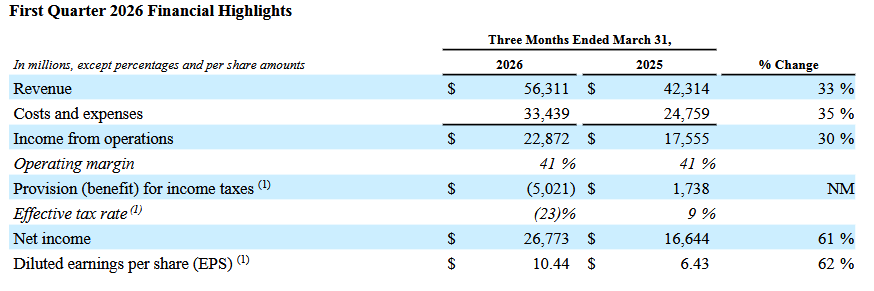
Revenue grew an impressive 33% to $56.31 billion and net income skyrocketed to 61% to $26.77 billion. The net income however is heavily distorted by a one time $8.03 billion income tax benefit. Corrected for that the net income rose by “just” 12.6% to $18.7 billion, still very impressive but a lot less dramatic than the revenue gain.
Capital expenditures were $19.84 for the quarter while free cash flow (after capital expenditures) was $12.39 billion. So for now the operating cash flow is enough to cover the capital expenditures.
Cash, cash equivalents and marketable securities stood at $81.18 billion as of March 31, 2026.
Can Meta fund this itself?
For full year 2026 capital expenditures in range of $125 – $145 billion are expected (increased $10 billion from previous expectations). In this AI race estimates tends to mostly land on the high end, so let’s assume $145 billion of which $19.84 billion is already spent in Q1. For the remainder of the year that leaves about $125 billion.
In 2025 the free cash flow before capital expenditures was $115.8 billion with a capital expenditure of $72.22 billion and $31.58 billion in dividends and share buybacks. Share buybacks were stopped in 2026 because all available money is needed for the increased capex.
It is of major importance whether Meta is able to pay for all the capex itself, or whether it will have to issue new shares as Alphabet had to do. Lets try make an estimate on full years 2026 and 2027. Traditionally, Q4 is the strongest due to holiday advertising spend, while the first quarter of the year is always weak.
| Cash flow | Cap Ex | Shareholders | Free cashflow | Cash position | |
| 2025 | 115.8 | 72.22 | 31.58 | 12.00 | 81.59 |
| 2026 Q1 | 32.23 | 19.84 | 1.35 | 11.04 | 81.18 |
| 2026 expected | 130-135 | 125-145 | 5.4 | ~ (15) | ~ 70 |
| 2027 guess | 145 | 155 | 5.4 | ~ (15) | ~ 55 |
The table tells a clear story: if spending tracks the high end of guidance and revenue growth continues at its current pace, Meta’s cash reserves will drift toward $55 billion by the end of 2027.
For a company the size of Meta a cash position of $50 billion is about the lowest it should comfortably hold to ensure operational resilience at all times. That floor is coming into view at the end of 2027. The cash flow will however, grow too; the investments made in 2026 and 2027 will start to pay off, and depreciation of those assets will more and more offset the CapEx burden.
The cash position of Meta will most likely be sufficient to support all planned AI investments. However, buybacks and large acquisitions will be off the table without raising external capital. This will make Meta more vulnerable to shocks than it has been in recent years, though it is worth noting that all major competitors face the same constraints. In an arms race where everyone is stretching their balance sheet, relative strength matters more than absolute comfort. And on that measure, Meta currently appears to be positioned among the best in the field at the moment.
Conclusion
Meta is making one of the largest corporate bets in history. The numbers are staggering, capex that exceeds the cash flow Meta is currently generating. This will put pressure on its cash reserves. Fortunately Meta’s cash reserves are massive; dividends have been kept low and share buy backs in the past were also moderate. Meta will now need that full war chest.
The honest conclusion from the available data; Meta will probably be able to fund this adventure. Though just barely, with little wiggle room. This would be a serious concern, were it not for the fact that all major competitors face the same challenge and Meta seems to be best positioned of them all. It remains unclear whether AI will deliver the results needed to justify all this spending. But it is likely that it will, at least in large part — and there is no way to avoid jumping on this wagon, since competitors will do so and surpass Meta if it stands still. All major tech companies are holding each other hostage in this race.
This is not a race where the cautious win — it is a race where the best-positioned survive. On that measure, Meta enters the back half of this decade with strong fundamentals, a dominant advertising business, and a management team that has shown it is willing to make hard bets.
What does this mean for my expectations of the Meta share price? I think Meta will be under significant selling pressure in the near term. The outflow of cash will be staggering while the early results will be moderate. However in the long run I think Meta will benefit and emerge stronger because of this investment. New income streams will be created.
With a P/E ratio of just 20, Meta looks very cheap. A proven major tech company with deep moats, high growth and a serious AI strategy. Now trading at around $580 per share; I see under $550 as a great entry point to slowly start building a position. No need to hurry though; this will take some time to play out. And even if AI disappoints, Meta is still a highly profitable company with a low earnings multiple and strong growth prospects that stand on their own.
This is not financial advice. Always do your own research before making investment decisions.